Dharavi Dreams: Why Hollywood's Hottest Directors Are Low-Key Obsessed With Mumbai's Streets
Dharavi Dreams: Why Hollywood's Hottest Directors Are Low-Key Obsessed With Mumbai's Streets
There's a moment that filmmaker Jordan Peele once described in a masterclass about visual storytelling — that feeling of walking into a place so densely alive, so layered with human experience, that your camera instincts just kick in. For a growing number of American directors, screenwriters, and streaming showrunners, that moment is happening not in New York or New Orleans, but in the winding, color-soaked lanes of Mumbai's most iconic neighborhoods.
Dharavi. Kurla. Dharavi again. And then Dharavi once more — because apparently, once isn't enough.
Something is shifting in the creative exchange between Hollywood and Bollywood, and it's running in a direction that might surprise you.
The City That Teaches You to See Differently
Mumbai has always been cinematic. Anyone who's ever stood at the edge of Dharavi at golden hour, watching the light cut through corrugated rooftops and land on a kid playing cricket in a two-foot-wide alley, already knows this. But what's new is that American filmmakers are starting to study it — not just visit it for inspiration tourism, but genuinely dissect it as a visual and narrative school.
Director Chloe Domont, who made waves with Fair Play on Netflix, has spoken publicly about how a research trip to Mumbai in 2021 changed her approach to shooting confined, high-pressure spaces. "There's a density to Mumbai's working-class neighborhoods that you can't replicate on a soundstage," she noted in a 2023 Filmmaker Magazine interview. "The way people exist in proximity to each other — it rewires how you think about tension and intimacy in the frame."
She's not alone. A wave of American creatives — particularly those working in prestige streaming — have quietly been making pilgrimages to Mumbai, attending screenings of films like Gully Boy, Slumdog Millionaire (the film that arguably kicked off this whole conversation), and more recent Indian productions like Mumbaikar and Dharavi Bank, absorbing not just the stories but the texture of how those stories are told.
From Slumdog to Streaming: The Lineage of Mumbai's Influence
Let's be real — this conversation can't happen without acknowledging Slumdog Millionaire. Danny Boyle's 2008 Oscar juggernaut was the first major Hollywood production to take Mumbai's street-level chaos and transform it into globally consumed cinema. But here's what's interesting: in the decade-plus since, the influence has gotten subtler, smarter, and a lot more mutual.
Amazon Prime's Citadel (the Russo Brothers' global spy franchise) recruited Indian co-directors Raj & DK for its Mumbai-set spinoff Citadel: Honey Bunny, which premiered in late 2024. The result was a production that felt authentically rooted in Mumbai's visual grammar — the crowded bus depots, the fluorescent-lit chawl interiors, the way action sequences breathe differently when every escape route is also someone's front door. American audiences ate it up. The show trended in the US for two straight weeks.
Over at Netflix, showrunners working on crime dramas have reportedly been using Sacred Games and Mirzapur as visual reference documents — not to copy them, but to understand how Indian filmmakers create menace and moral ambiguity in spaces that are simultaneously suffocating and beautiful.
"The American crime drama has a certain grammar — wide streets, muscle cars, that kind of open-road despair," said one writer's room source on a major Netflix crime series currently in production. "Mumbai flips that. The danger is intimate. It's in the crowd. That's a completely different emotional register, and we're trying to learn it."
Dharavi as a Film School Nobody Officially Enrolled In
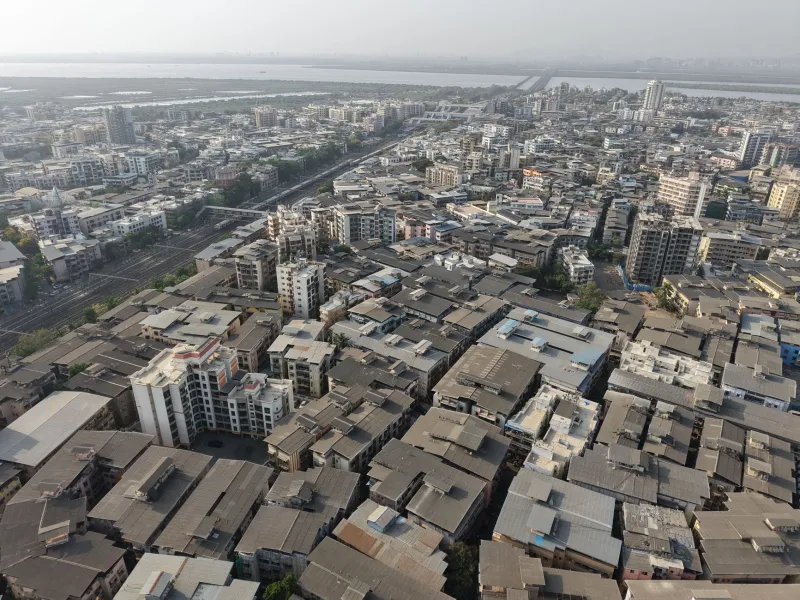
What makes Dharavi specifically so magnetic to outside filmmakers? It's not poverty voyeurism — at least not in the more thoughtful cases. It's the economy of space. Dharavi, one of Asia's largest urban settlements, functions as a micro-city within a mega-city. It has its own industries, social hierarchies, creative subcultures, and yes, its own deeply cinematic visual rhythm.
Film location scouts from LA have been quietly cataloguing Mumbai neighborhoods for years. Production designer Annie Atkins, known for her work with Wes Anderson, has cited Indian street typography and signage as a major influence on her aesthetic vocabulary. The hand-painted shop fronts of Mumbai's older commercial districts — Dadar, Bandra, Bhendi Bazaar — carry a visual warmth and imperfection that no digital font can replicate.
Beyond aesthetics, it's the narrative density that's drawing writers. Dharavi is a place where a leather goods workshop, a recycling operation, a family home, and a street food stall can coexist within fifty square feet. That kind of compressed human drama is a screenwriter's dream.
The Love Story Is Mutual — And That Matters
Here's the part that often gets lost in these cultural exchange conversations: Bollywood isn't just sitting back and letting Hollywood mine its streets for inspiration. Indian filmmakers are equally fascinated by American storytelling structures, particularly the prestige TV model of slow-burn character development and morally complex anti-heroes.
The result is a genuine creative dialogue. Directors like Zoya Akhtar (Gully Boy, Made in Heaven) have spoken about how American indie cinema — particularly the work of Benh Zeitlin and Barry Jenkins — influenced their approach to representing Mumbai's underclass with dignity rather than spectacle. Jenkins' Moonlight, with its tender, intimate gaze at a marginalized community, resonated deeply with Indian filmmakers working in similar emotional territory.
This is what makes the current moment so exciting. It's not cultural appropriation — it's cultural conversation. Two film industries that grew up on opposite sides of the planet, both obsessed with the drama of ordinary human lives, are finally sitting down at the same table.
What This Means for American Audiences
For viewers in the US, this cross-pollination is already showing up on your screens — sometimes obviously, sometimes in ways you'd never consciously clock. That Netflix thriller with the unusually claustrophobic action choreography? Mumbai influence. That streaming drama where the family conflict unfolds across a single, densely populated apartment building? Mumbai influence.
And as more American productions either shoot on location in India or hire Indian creative collaborators, that influence is only going to deepen. The next generation of American filmmakers isn't just watching Bollywood as a curiosity — they're treating it as curriculum.
Dharavi didn't ask to become a film school. But somehow, it became one of the most important ones on earth. And Hollywood is finally showing up to class.