Talk to the Hand: How Bollywood's Ancient Gesture Code Is Breaking Into American Pop Culture
Talk to the Hand: How Bollywood's Ancient Gesture Code Is Breaking Into American Pop Culture
There's a moment in almost every Bollywood film that stops you cold. Not a dramatic monologue. Not an explosion. Just a dancer's hand — curved, deliberate, impossibly precise — telling you something words simply cannot. If you've been watching and thinking what just happened to me, you're not alone. Americans across the country are currently deep in a rabbit hole trying to figure out exactly that. Welcome to the world of mudras, and buckle up because this is about to rewire how you think about body language entirely.
What Even Is a Mudra?
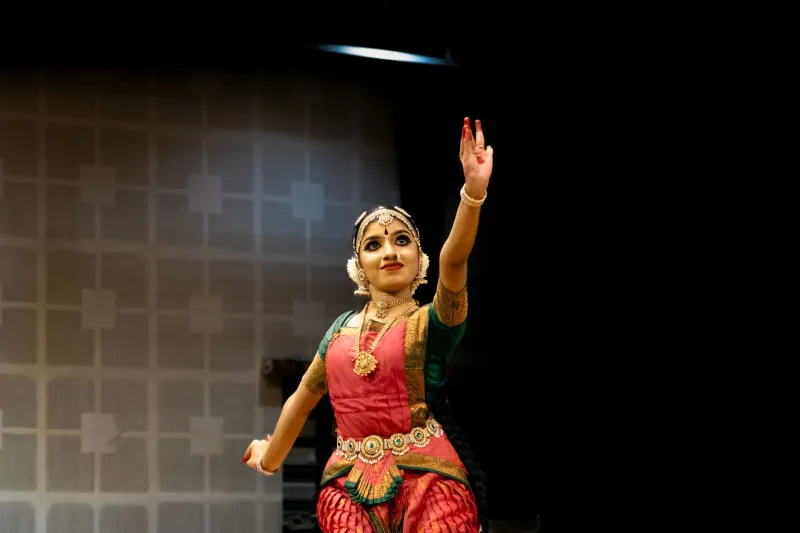
Let's start at the beginning. A mudra — pronounced moo-dra — is a symbolic hand gesture rooted in Hindu and Buddhist spiritual practice, with origins stretching back thousands of years. The word itself translates loosely to "seal" or "sign" in Sanskrit. These gestures show up in ancient temple sculptures, yoga meditation, Ayurvedic healing traditions, and at the beating heart of Indian classical dance forms like Bharatanatyam, Kathak, Odissi, and Manipuri.
In classical Indian performance, there are two main categories. Asamyuta mudras use a single hand — think of the famous "Pataka" gesture, where the hand is held flat with fingers pressed together, used to represent everything from a blessing to the wind to a king's royal declaration. Samyuta mudras combine both hands to create compound meanings, like the "Anjali" — palms pressed together at the chest — which most Americans already recognize from yoga class as Namaste.
Here's the wild part: trained classical dancers can communicate entire stories using nothing but these gestures. A single hand position can mean "lotus flower," "moon," "fish," "arrow," or "love" depending on how it's combined with eye movement, facial expression, and body posture. It's essentially a full visual language, and Bollywood directors have been borrowing from it for decades.
Bollywood Borrowed It and Made It Electric
When Hindi cinema exploded into its golden age in the 1950s and 60s, choreographers like Lachhu Maharaj and Gopi Krishna brought classical Kathak precision directly onto the film screen. Actresses like Waheeda Rehman and Hema Malini weren't just dancing — they were speaking an entire poetic vocabulary with their fingertips.
Fast forward to the modern era and you've still got it everywhere, just remixed. Remember the iconic "Dola Re Dola" sequence from Devdas featuring Madhuri Dixit and Aishwarya Rai? Every sweeping arm, every curled finger, every wrist rotation in that number is pulling from a classical grammar that's been refined over two millennia. Madhuri Dixit — arguably Bollywood's greatest dancing actress — has spoken in interviews about how she trained extensively in Kathak specifically so her hand movements could carry emotional weight independently of her face.
Even in more contemporary, high-energy numbers, you'll catch it. Watch Deepika Padukone in "Nagada Sang Dhol" or any of the big Bajirao Mastani sequences and look at what her hands are doing between the big spins. That's not random. That's trained intention.
TikTok Just Discovered This and Is Absolutely Spiraling
Here's where it gets really fun for American audiences. Over the past year, a wave of TikTok creators — many of them South Asian American dancers sharing their classical training backgrounds — started breaking down specific Bollywood hand movements for mainstream audiences. The videos are racking up millions of views, and the comments sections are pure chaos in the best possible way.
Non-Indian viewers are genuinely stunned to learn that what looked like beautiful ornamentation is actually a codified communication system. Creators like @classicaldancebreak and various Bharatanatyam instructors with massive followings have been posting side-by-side comparisons: the ancient temple carving of a gesture next to a Bollywood film still showing the exact same hand position. The visual payoff is jaw-dropping.
Yoga communities in the US are also feeding this obsession from a different angle. Practitioners who've spent years using mudras in meditation — the Gyan mudra (index finger touching thumb, associated with knowledge and clarity) is basically yoga's most famous hand position — are now connecting the dots to Bollywood choreography and having genuine revelations. It's the same gesture, just dressed differently depending on whether you're in a Rishikesh ashram or a Mumbai film studio.
The Spiritual Circuitry Behind the Movement
This is where things get genuinely mind-bending. In Ayurvedic and yogic philosophy, each finger corresponds to a specific element and energy channel in the body. The thumb represents fire. The index finger represents air. The middle finger connects to space or ether. The ring finger governs earth. The pinky links to water.
When you form a mudra, you're essentially completing an energetic circuit — directing the flow of prana, or life force, through the body in specific ways. Practitioners believe this influences not just mood and focus but actual physiological states. Whether or not you're sold on the metaphysics, the research on hand-brain connection is legitimately interesting. Neuroscientists have documented that fine motor movements of the hand activate significant portions of the brain's sensory and motor cortex. There's something happening when you move your hands with precision and intention, even if Western science is still working out exactly what.
For performers, the effect is almost meditative. Dancers trained in classical Indian forms frequently describe entering a flow state during performance that's partly triggered by the ritualistic precision of the hand vocabulary. American theater and dance coaches are starting to pay attention to this.
How to Start Your Own Mudra Journey (Without Being Weird About It)
You don't need to enroll in a classical dance conservatory to start playing with this. Here are three beginner-friendly gestures that'll immediately make your yoga practice feel deeper, your meditations more grounded, and honestly your Instagram content more visually interesting:
Anjali Mudra — You already know this one. Palms together, fingers pointing upward. In both yoga and Bollywood choreography, this signals reverence, greeting, and connection. Start here.
Gyan Mudra — Touch the tip of your index finger to the tip of your thumb, keep the other three fingers extended and relaxed. This is the gesture of knowledge and consciousness. It appears constantly in Bollywood scenes involving a guru, a wise elder, or a moment of spiritual reckoning.
Pataka — Hold your hand flat, fingers pressed firmly together, thumb tucked slightly. This is one of the most versatile gestures in classical Indian dance, used to represent a flag, a forest, the sky, a river, or a royal decree depending on context. Watch for it in literally every traditional Bollywood dance sequence ever filmed.
Why This Matters Right Now
America has spent years borrowing pieces of Indian culture — the yoga, the chai, the henna — and now we're finally starting to understand the connective tissue. Mudras aren't just pretty hand shapes. They're a communication technology developed over thousands of years by people who understood that the body speaks in frequencies words can't reach.
Bollywood has been broadcasting this language at Hollywood-level production values for decades. The fact that it's taken this long for mainstream American audiences to tune in is honestly kind of embarrassing — but also kind of exciting, because the discovery feels fresh and electric right now.
So next time you're watching a Bollywood number and a dancer's hand catches you somewhere in your chest? That wasn't an accident. That was a sentence. You just didn't know the language yet. Now you're starting to.