Why Indian Immigrants Are Chasing Rain Clouds to Seattle and Portland — and What It's Doing to the Housing Market
Conventional wisdom says immigrants move toward sunshine. Florida. California. Arizona. The places that promise warmth and light and the visual opposite of hardship. The data on Indian immigration to the US has, for decades, largely supported this — the South Asian diaspora clustered heavily in the Bay Area, Southern California, Houston, and the New Jersey suburbs of New York.
So why are real estate agents in Seattle increasingly fielding calls from families relocating from Mumbai? Why are South Asian restaurant owners opening in Portland at a rate that has local food writers paying attention? And why, when you ask these transplants directly, do so many of them say something that sounds almost poetic: it rains here like it rains at home?
Monsoon Is Not Just Weather — It's a Feeling
To understand what's happening, you have to understand what monsoon season actually means to someone who grew up in Mumbai or any part of the Indian subcontinent. This isn't just precipitation. Monsoon is a cultural event, an emotional season, a full sensory experience that arrives every year between June and September and restructures daily life around it.
The smell of the first rain hitting dry earth — called petrichor, but known in Hindi as mitti ki khushboo — is one of the most universally beloved scents in Indian culture. Bollywood has made entire careers out of rain songs. Tip Tip Barsa Paani, Rimjhim Gire Saawan, Barso Re — the monsoon sequence is practically its own genre of Hindi cinema, and it carries enormous emotional weight for anyone who grew up watching these films while the actual rain poured outside.
When Indian immigrants land in Phoenix or Las Vegas or even Los Angeles, they find sunshine and efficiency and comfort. What they often don't find is that specific melancholy-joy that comes from a grey sky and the sound of rain on a tin roof. After a few years, some of them start looking for it.
Seattle's Quiet Demographic Shift
Real estate professionals in the Pacific Northwest have been noticing this pattern with increasing clarity over the past five to eight years. South Asian buyers — particularly those with roots in coastal Indian cities like Mumbai, Chennai, and Kochi, which have intense monsoon seasons — are showing up in the Seattle and Portland markets with a specific set of preferences that don't quite match the typical buyer profile.
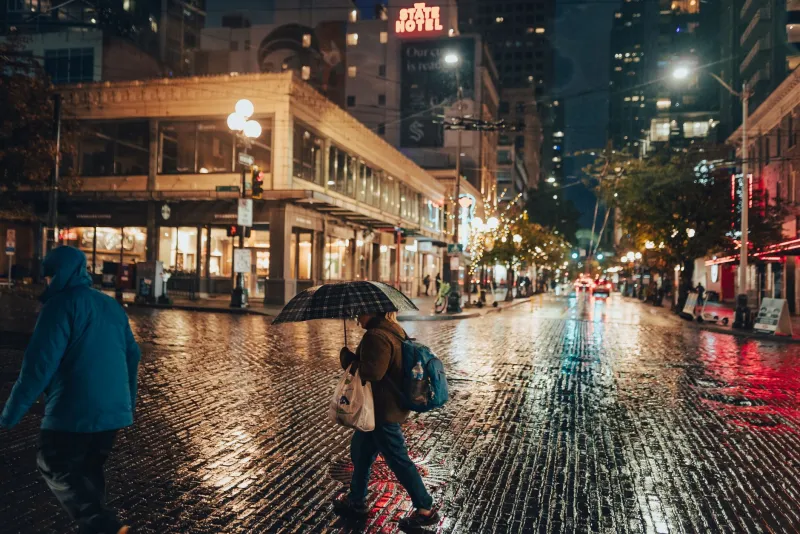
They're often less concerned about proximity to beach or outdoor recreation than comparable buyers. They tend to prioritize covered outdoor spaces — porches, patios, verandas — in a way that reflects a lifetime of watching rain from a sheltered spot. And they respond positively to the grey, layered skies that most Pacific Northwest natives grumble about from November through April.
Rajesh Menon, a real estate broker in Bellevue, Washington, who has worked extensively with South Asian buyers, describes showing a couple from Pune their first Seattle property on a rainy Tuesday. "The wife walked out onto the back deck and just stood there in the drizzle for a minute. Then she turned to her husband and said something in Marathi. Later he told me she said, 'This one feels like home.' We wrote the offer that afternoon."
The Restaurant and Culture Economy That Follows
Where diaspora communities settle, their culture follows — and the Pacific Northwest is experiencing a genuinely interesting wave of South Asian food and entertainment investment that reflects this shift. Portland has seen a notable cluster of new Indian restaurant openings in the past three years, with a particular emphasis on coastal and street food — the kind of food that tastes best eaten during a downpour.
Think Mumbai-style vada pav, Goan fish curry, the kind of chai that's made on a stove rather than a machine. These aren't the generic Indian-American curry houses that have existed in every American city since the eighties. They're specific, regional, and they're serving communities that have very particular ideas about what authentic means.
Beyond food, there's a growing infrastructure of South Asian cultural life in both cities — Bollywood dance studios, Hindi film screening events, Diwali celebrations that have grown substantially in recent years. The monsoon-seeking immigrant isn't just looking for weather; they're building an environment that holds multiple dimensions of home simultaneously.
What This Reveals About Diaspora Psychology
The monsoon migration pattern touches something genuinely profound about what home means to people who've moved across the world. Home is almost never a single thing. It's a layered sensory experience — the smell of specific food, the quality of specific light, the sound of rain in a particular way on a particular surface. When immigrants describe homesickness, they're rarely describing a building or a street. They're describing a feeling that those physical details produced.
The Pacific Northwest's weather, for many South Asian transplants, functions as a sensory bridge — a way of accessing an emotional register that sunny American cities simply can't provide. It's not that Seattle is like Mumbai. It's that the grey sky and the rain and the particular mood they create overlap enough with monsoon memory to produce something that feels, in a specific and meaningful way, like belonging.
Dr. Ananya Krishnan, a cultural psychologist at the University of Washington who studies diaspora identity, frames it this way: "We talk a lot about food and language as carriers of cultural identity, and they are. But climate is underrated as an emotional anchor. The body remembers weather. It associates certain sensory conditions with safety, with family, with childhood. When immigrants find a new place that activates those associations, even partially, the psychological effect can be significant."
The Housing Market Implications
For a practical look at what this means in real estate terms: South Asian buyers are contributing to demand in Seattle and Portland neighborhoods that other demographic groups have been leaving. They're often dual-income professional households with strong purchasing power and a long-term settlement orientation — they're not buying starter homes; they're buying places they intend to stay.
This has implications for neighborhood development, school enrollment patterns, commercial real estate, and the local restaurant and retail economy. The monsoon migrants are, in a quiet and unannounced way, reshaping specific zip codes.
None of this was planned. No relocation consultant recommended Seattle for its resemblance to the subcontinent. No marketing campaign targeted Mumbai expats with Pacific Northwest lifestyle content. It emerged organically from something much more primal: the human need to find, in a foreign place, at least one thing that feels like the sky you grew up under.
And honestly? That might be the most Bollywood thing about this whole story. Even the real estate decisions are romantic.