From Bridal Ceremony to Coachella Canopy: How Henna Became America's Wildest Beauty Obsession
From Bridal Ceremony to Coachella Canopy: How Henna Became America's Wildest Beauty Obsession
Picture this: It's a sweltering Friday afternoon at Coachella, and somewhere between the overpriced açaí bowls and the neon art installations, there's a line snaking around a pop-up tent. Inside, an artist is bent over someone's forearm, tracing intricate floral patterns with a tiny cone of dark paste. The customer? A twenty-three-year-old from Ohio who learned about henna from a TikTok she watched at 2 a.m. three weeks ago.
This is the mehendi moment, and it's happening everywhere.
Henna — or mehendi, as it's known across South Asia and beyond — has been part of Indian, Pakistani, Bangladeshi, North African, and Middle Eastern cultures for thousands of years. It's applied at weddings, Eid celebrations, baby showers, and coming-of-age ceremonies. The smell of it, earthy and a little sharp, is deeply tied to memory for millions of people. And now it's showing up at bachelorette parties in Nashville, farmer's markets in Portland, and yes, festival grounds across the American Southwest.
So how did we get here? And more importantly — what does it mean?
The Wedding Room That Started Everything
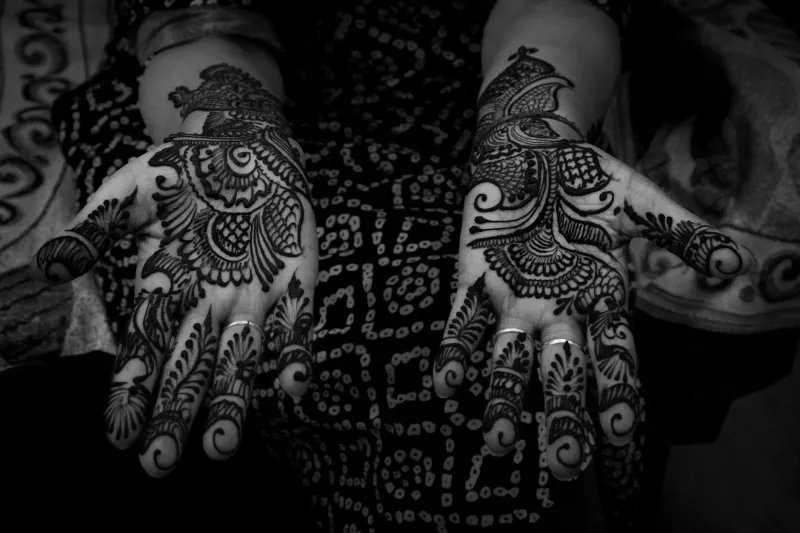
For most Indian-American families, the mehendi ceremony is one of the most joyful nights of a wedding week. The bride sits at the center of the room while the artist — often someone who has been doing this for decades — works for hours, covering hands and feet in elaborate, story-filled designs. Guests get smaller patterns on their palms. Music plays. Relatives argue about whose design is better. It's chaotic and gorgeous and completely irreplaceable.
This is where many non-South Asian Americans first encountered henna — as guests at a friend's wedding, or through a college roommate, or in a documentary about Indian culture. The curiosity was always there. What changed is that social media gave it a runway.
Instagram made henna visual in a way that translated perfectly to the platform. A freshly applied design on a sun-kissed hand? That's a post. A time-lapse of an artist working through a complex mandala pattern? That's a Reel with half a million views. TikTok pushed it even further, turning henna tutorials into a cottage industry and making DIY kits a household staple.
The Artists Keeping It Real
Nisha Patel has been doing mehendi professionally for eleven years. She grew up in New Jersey, learned the craft from her grandmother over summers spent in Gujarat, and now runs a henna studio in Jersey City that books out weeks in advance. Her clientele is a mix of South Asian brides, curious newcomers, and everyone in between.
"I love that more people want henna," she says, arranging her cones before a Saturday rush. "But I do think a lot about what gets lost when it travels. The patterns mean something. The placement means something. When someone just wants a butterfly on their wrist because it looks cute, that's fine — but I always try to tell them a little of the story behind what I'm drawing."
That instinct to educate is something many Indian-American practitioners share. They're not gatekeeping — they're contextualizing. There's a difference, and it matters.
On the other side of the conversation, artists like Maya Rodriguez, a Mexican-American henna artist based in Los Angeles, have built careers around the craft after falling in love with it at a cultural fair in their early twenties. Maya is transparent about her background and deliberately collaborates with South Asian and North African artists to keep learning.
"I think the question isn't whether someone who isn't Indian can do henna," Maya says. "The question is whether you're doing it with respect and awareness, or just because it's trending."
Coachella, Celebrities, and the Viral Machine
Celebrity influence has been massive. When Beyoncé's Renaissance era brought an explosion of global aesthetic references, henna imagery spiked in searches almost overnight. Rihanna has been photographed with henna-style designs. Lizzo showed up to an event with elaborate hand art. Each moment sent a wave of new interest crashing through beauty communities online.
Music festivals became ground zero. Coachella, Lollapalooza, and Governors Ball now regularly feature henna artists as part of their vendor lineups, right alongside tarot readers and flower crown stations. The demand is real and it's growing.
Beauty brands noticed. Temporary henna-inspired tattoo kits started appearing at Ulta and Target. Major nail brands launched mehendi-influenced nail art collections. The aesthetic — geometric, floral, deeply intricate — has filtered into everything from phone cases to wallpaper to wedding invitation design.
The Appreciation vs. Appropriation Tightrope
Here's where it gets complicated, and honestly, where it gets interesting.
Cultural appreciation versus appropriation is one of the most debated topics in modern American discourse, and henna sits right in the middle of it. The conversation isn't simple, and it shouldn't be flattened into easy takes.
Many South Asian voices welcome the spread of henna, seeing it as a form of cultural exchange that brings visibility and economic opportunity to artists from their communities. Others feel a sting when they see henna divorced entirely from its context — sold as a generic "boho" accessory with no acknowledgment of its roots.
The most common frustration? When the same South Asian students who were mocked for smelling like henna paste as kids watch their non-South Asian classmates get praised for being "so unique" for wearing it. That double standard is real, and naming it matters.
Nisha puts it plainly: "I don't want people to stop getting henna. I want them to know where it comes from. Ask your artist about it. Tip them well. Learn one thing. That's all."
What the Trend Gets Right
For all the complexity, something genuinely beautiful is happening here. Henna is bringing people into conversations about South Asian culture that might never have happened otherwise. A teenager in rural Kansas who got henna at a fair and then went down a rabbit hole learning about mehendi ceremonies is now someone who understands a little more about a culture that wasn't part of their upbringing.
That's not nothing. That's actually kind of everything.
And the economic impact on South Asian artists — particularly women, who have historically dominated the craft — has been significant. Henna artists who once worked only the wedding circuit are now booked at corporate events, bachelorette weekends, and luxury pop-ups. The market has expanded in ways that directly benefit practitioners from the communities where mehendi originated.
The Paste Is Still Wet
Henna isn't going anywhere. If anything, it's still accelerating. New artists are emerging, new styles are developing — from ultra-minimalist single-line designs to bold geometric patterns that blend traditional South Asian motifs with contemporary aesthetics — and the conversation around it is getting more nuanced by the month.
What started in the bridal rooms of Mumbai and Lahore and Dhaka has found its way to the wrists of America, and the story of how it traveled is as intricate as the designs themselves. The best thing anyone can do — wearer or artist or curious onlooker — is lean into that complexity rather than flatten it.
Get the henna. Ask about the tradition. Tip your artist. And maybe, just maybe, look up a mehendi ceremony video when you get home. You won't regret it.