Draped, Dangerous, and Completely Everywhere: How the Saree Quietly Took Over American Fashion
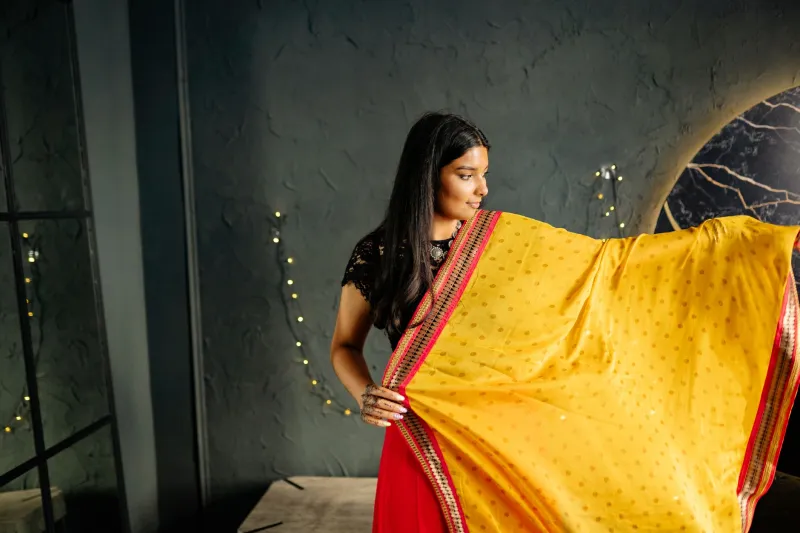
Somewhere between a Brooklyn rooftop party and a New York Fashion Week after-show, something shifted. The saree — six yards of fabric that has draped the bodies of Indian women for over five thousand years — started showing up in places nobody expected. Not as a costume. Not as a themed accessory. As fashion. Real, runway-ready, street-style-approved fashion.
And American designers? They are absolutely losing their minds over it.
From Ceremony to Street: The Saree's Unexpected American Glow-Up
For a long time, the saree occupied a very specific lane in the American imagination. It was beautiful, sure. Exotic, definitely. But wearable outside of a Diwali celebration or a South Asian wedding? That felt like a stretch for most American women.
Not anymore.
Over the past two years, something has fundamentally changed in how the saree is being perceived, styled, and sold in the United States. Stylists on both coasts are draping clients in pre-stitched saree gowns for red carpet events. Emerging American designers are pulling directly from the aesthetic — fluid, body-skimming silhouettes with one shoulder or a dramatic pleated front — and calling it their most-requested look. Fashion influencers with zero South Asian heritage are posting saree styling tutorials that rack up millions of views.
This is not a trend. This is a takeover.
The Designers Who Saw It Coming
Talk to enough people in the American fashion world right now and you'll keep hearing the same thing: the saree solved a problem that Western fashion has been struggling with for years. The problem of drape.
Western fashion has always been obsessed with structure — seams, zippers, tailoring, the geometry of cut. But the saree operates on completely different logic. It's a single piece of unstitched fabric that creates shape entirely through the art of wrapping. That fluidity, that effortless movement, that sense of the body existing inside the garment rather than being contained by it — American designers are chasing exactly that feeling.
New York-based designers have been quietly incorporating saree-style draping into eveningwear collections, creating one-shoulder gowns with cascading pleats that reference the pallu — the decorative end of the saree that typically falls over the shoulder. Los Angeles-based stylists working with celebrity clients have started sourcing pure silk saree fabric from Indian textile houses in Varanasi and Surat, using it to construct custom pieces that carry that unmistakable luminosity you simply cannot fake with synthetic alternatives.
The fabric itself is part of the story. Kanjivaram silk, Banarasi brocade, Chanderi cotton — these are materials that American fashion has barely scratched the surface of, and designers who've discovered them are treating them like a secret weapon.
Real Women, Real Wardrobes
The runway conversation is exciting, but what's actually more interesting is what's happening at street level.
American women — not just South Asian Americans, but women of every background — are incorporating saree-inspired pieces into their everyday wardrobes in ways that feel genuinely fresh rather than appropriative or costumey. The key has been styling: pairing a saree-draped skirt with a fitted crop top, or layering a sheer saree fabric over a slip dress as an evening layer. Instagram and TikTok have been enormous drivers here, with creators developing entire aesthetics around what some are calling "New Desi" — a hybrid visual language that blends Indian textile traditions with contemporary Western silhouettes.
Women in cities like Chicago, Atlanta, and Houston have been especially enthusiastic adopters. Many cite the same reason: the saree, even in its most adapted Western form, makes them feel like they're wearing something that has actual weight to it. History, craftsmanship, intention. In an era of fast fashion and throwaway trends, that resonates deeply.
The Red Carpet Moment That Changed Everything
If there was a single inflection point that pushed the saree from cultural conversation to mainstream fashion statement, many industry observers point to a string of high-profile red carpet appearances over the last couple of years where non-South-Asian celebrities showed up in saree-inspired looks — and got it right.
The difference between those moments and the cringe-inducing missteps of the past? Collaboration and credit. The looks that landed were created in partnership with Indian designers, styled with input from South Asian fashion consultants, and worn by people who talked openly about the inspiration and craftsmanship behind what they had on. American audiences responded to that transparency. It felt like appreciation rather than extraction.
Bollywood, as always, had already been there. Stars like Deepika Padukone and Alia Bhatt have long demonstrated that the saree can occupy the same visual space as a Valentino gown or a custom Versace — it just requires the confidence and styling vision to pull it off. American fashion is finally catching up to what Mumbai already knew.
Why This Isn't Going Anywhere
Fashion trends come and go. The saree is not a trend. That's the most important thing to understand about what's happening right now.
What American fashion is discovering is not a new silhouette or a fresh color palette — it's an entirely different philosophy of dressing. The saree doesn't conform to the body; it converses with it. It moves differently, photographs differently, and makes the wearer feel differently than anything in the Western fashion canon. Once you experience that, it's very difficult to go back to treating it as a novelty.
Indian textile artisans, many of whom have been watching their traditional crafts struggle against fast fashion economics, are also seeing real opportunity in this moment. Export inquiries from American boutiques and designers have reportedly increased significantly. Weavers in Varanasi who produce Banarasi silk are getting orders from buyers in New York and Los Angeles who, two years ago, wouldn't have known what Banarasi meant.
That's not just a fashion story. That's an economic story, a cultural story, and honestly, a pretty beautiful one.
The Bottom Line
The saree has been the most sophisticated garment in the world for millennia. American fashion just took a while to figure that out. Now that it has, expect to see saree-inspired draping, Indian textiles, and the broader visual language of South Asian style showing up in every corner of the US market — from Target collaborations to Met Gala looks.
Mumbai has known the power of a perfectly draped saree forever. America is just getting the memo. And honestly? Welcome to the party.